
The Age of Real-Time Enterprises: Why Static Businesses Will Disappear
In 2026, speed is no longer an advantage — it is the price of admission. Real-time enterprises are reshaping global competition, leaving slow, static businesses with no room to survive.
Introduction: The New Operating Reality of Business
For decades, businesses were built on delayed information.
- Monthly reports
- Weekly reviews
- Daily summaries
- Manual coordination
- Human-driven follow-ups
This lag was normal — even acceptable.
But the business environment of 2026 is vastly different.
Consumers move faster.
Competitors move faster.
Markets move faster.
Technology evolves faster.
And companies operating on delayed data, manual processes, and siloed systems simply cannot keep up.
Today’s competitive advantage comes from one thing:
Real-time execution.
Not plans.
Not promises.
Not reports.
Execution — measured and managed in real time.
This is the foundation of the Real-Time Enterprise (RTE).
1. What Is a Real-Time Enterprise? The Simple Definition
A Real-Time Enterprise is a business where:
✔ data flows automatically
✔ decisions happen instantly
✔ processes run without manual triggers
✔ teams operate on live information
✔ leaders see the business as it is, not as it was
The opposite — a static business — relies on:
❌ outdated reports
❌ human follow-ups
❌ guesswork
❌ slow decision cycles
❌ disconnected tools
This static model was workable in 2010.
Barely survivable in 2020.
Fatal in 2026.
2. Why Static Businesses Are Disappearing
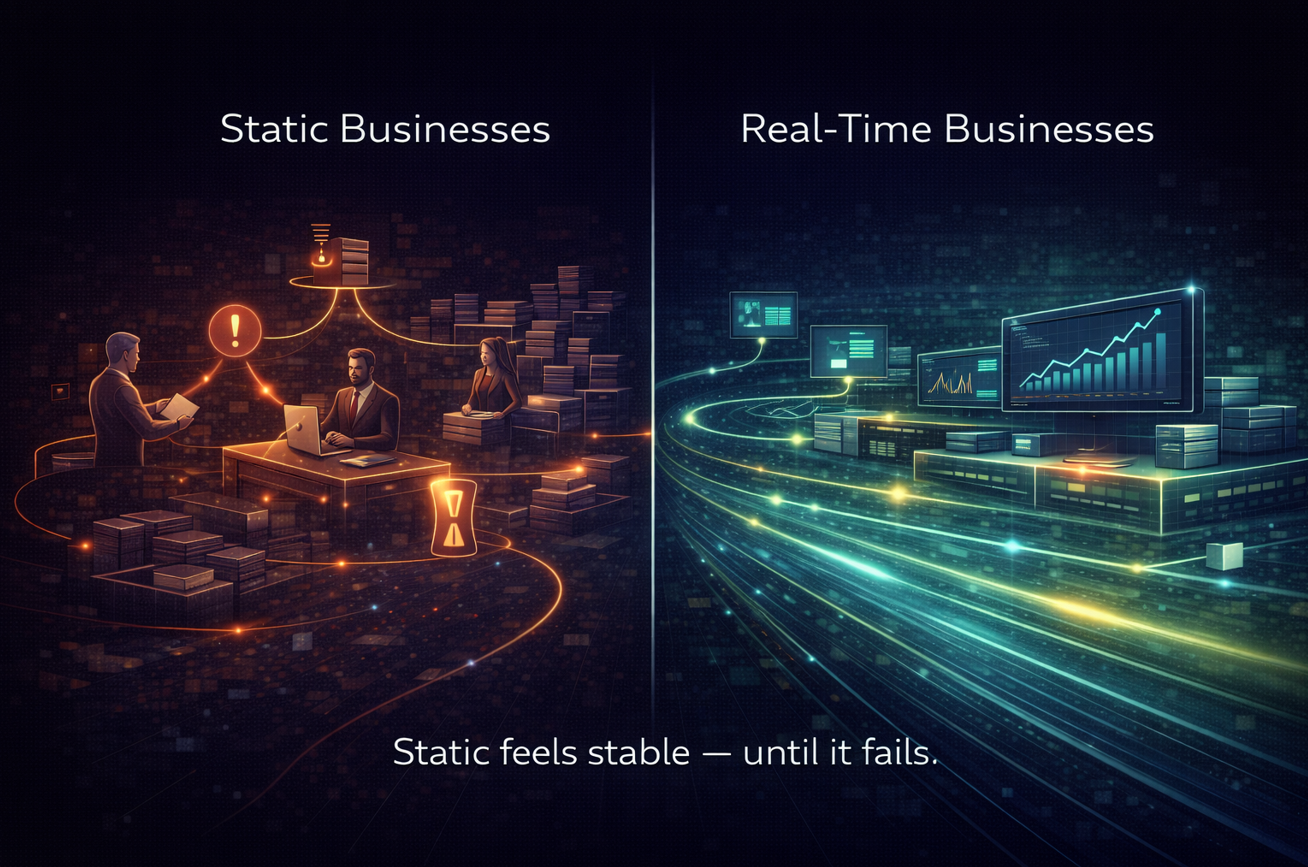
Static businesses fail not because of bad products — but because of:
(1) Slow internal communication
When team members must “check and confirm,” decisions stall.
(2) Missing or delayed data
Leaders fly blind, making poor choices based on outdated information.
(3) Manual processes that cannot scale
Growth increases complexity — and humans cannot keep up.
(4) Lack of visibility and accountability
Without real-time data, leaders cannot detect issues early.
(5) Inconsistent customer experience
Slow responses and unclear processes drive customers away.
Businesses running this way appear stable but are silently drowning in inefficiency.
Meanwhile, competitors using real-time systems operate at 3x the speed — and win the market.
3. The Three Pillars of Real-Time Enterprises
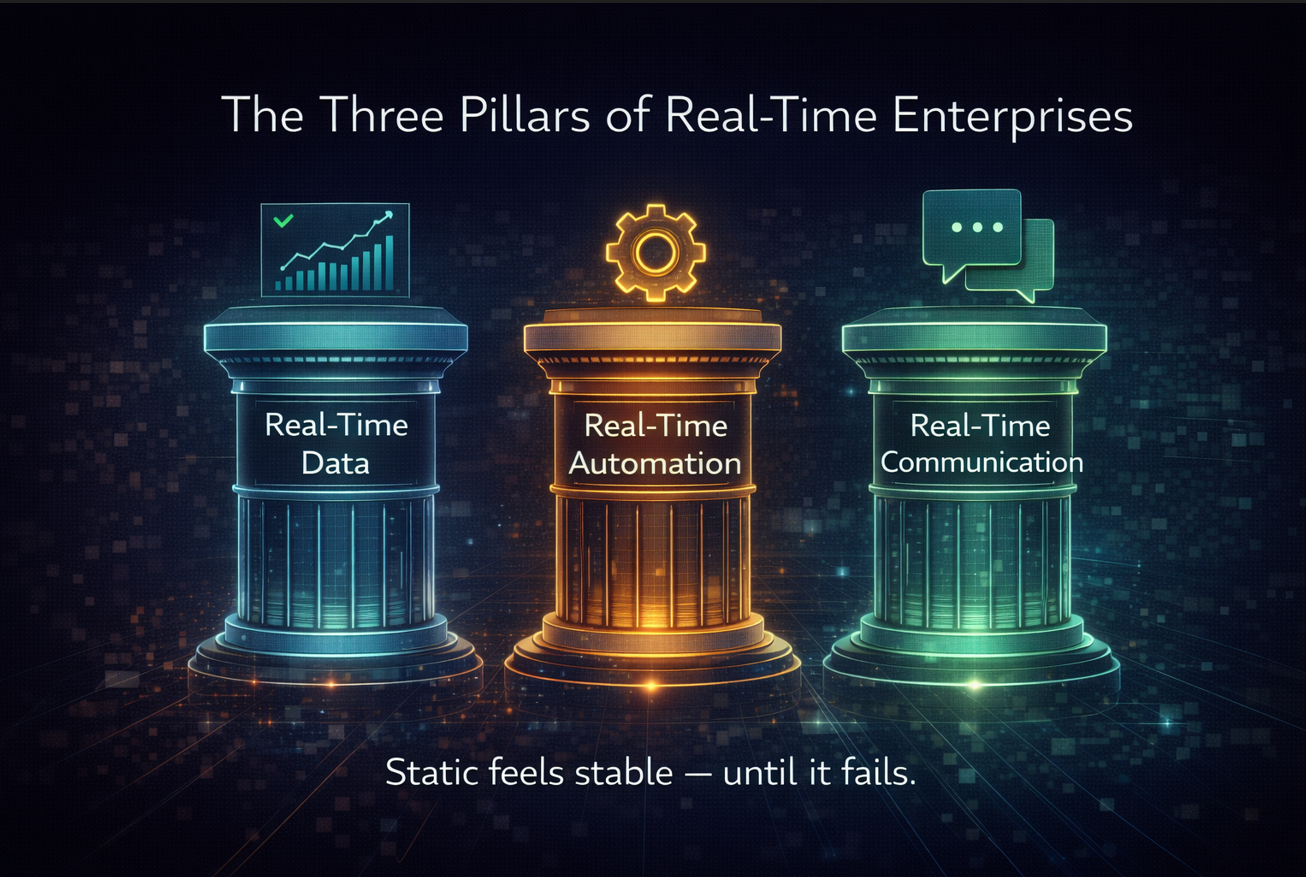
Every Real-Time Enterprise is built on three non-negotiable pillars:
Pillar 1: Real-Time Data
Not yesterday’s numbers.
Not last week’s report.
Not month-end summaries.
But live dashboards showing:
- sales now
- leads now
- cash flow now
- attendance now
- inventory levels now
- performance now
Because decisions should match reality — not history.
Pillar 2: Real-Time Automation
Automation removes delays caused by human bottlenecks:
✔ follow-ups
✔ approvals
✔ reminders
✔ stock updates
✔ invoicing
✔ allocations
✔ reporting
If a task is repeatable, it should be automated.
Humans should manage strategy — not repetitive work.
Pillar 3: Real-Time Communication
Teams operate in perfect sync when:
✔ updates are instant
✔ clients receive timely notifications
✔ departments share information seamlessly
✔ alerts are triggered automatically
✔ escalations happen without manual intervention
Real-time communication creates real-time execution.
4. The Business Impact of Becoming a Real-Time Enterprise
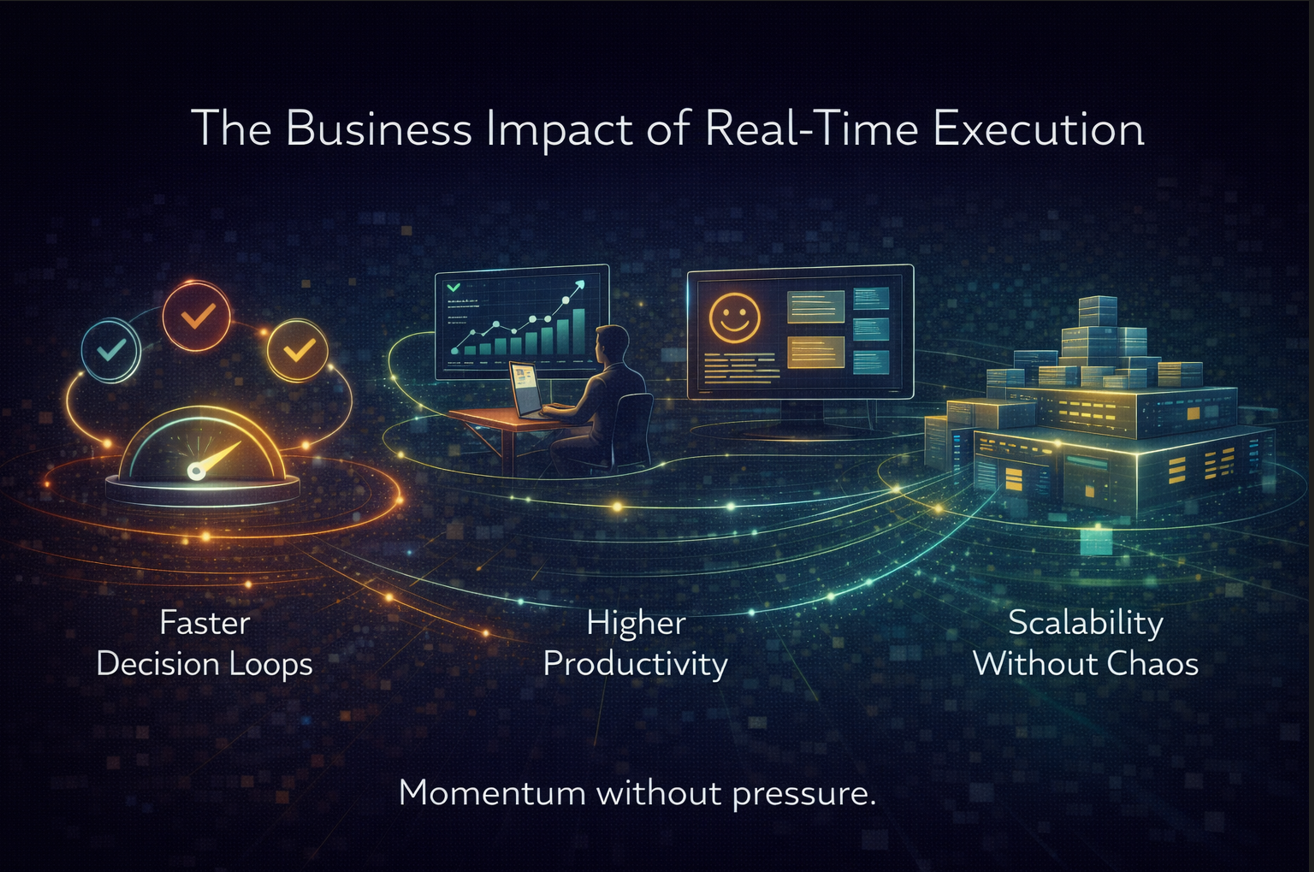
Real-Time Enterprises outperform static competitors across every business metric.
A) Faster Decision-Making
Decision cycles shrink from weeks → days → hours → minutes.
Leaders:
✔ catch issues before they grow
✔ identify opportunities early
✔ allocate resources intelligently
This agility becomes a market advantage.
B) Higher Team Productivity
Automation removes repetitive tasks.
Employees focus on high-value work.
Teams shift from:
❌ reacting → ✔ executing
❌ waiting → ✔ doing
❌ following up → ✔ creating
C) Higher Customer Satisfaction & Retention
Customers experience:
✔ faster responses
✔ accurate updates
✔ consistent communication
Better experience → stronger loyalty → higher revenue.
D) Reduced Operational Cost
Automation lowers costs by:
- eliminating errors
- reducing rework
- improving accuracy
- cutting time wastage
- preventing overstaffing
Real-time systems pay for themselves.
E) Scalability Without Chaos
Static businesses break when they scale.
Real-time enterprises expand effortlessly through:
✔ multi-branch visibility
✔ cross-location coordination
✔ centralized dashboards
✔ standardized workflows
Scaling becomes a strategy — not a struggle.
5. What Keeps Businesses From Becoming Real-Time?
Despite the benefits, many companies still operate manually.
Here’s why:
1. “We have always done it this way.”
Comfort kills innovation.
2. Lack of visibility into the hidden costs of manual operations
Static businesses don’t realize how much inefficiency they carry.
3. Fear of change from employees
Teams worry automation will replace them — reality is the opposite.
4. Poor choice of tools
Multiple disconnected softwares create more chaos, not less.
5. Leadership underestimates the power of real-time information
Many leaders assume monthly reporting is enough — it is not.
These barriers are psychological and strategic — not technological.
6. The Framework: How a Business Becomes a Real-Time Enterprise
Here is a simple 6-step framework used by fast-growing companies in 2026.
Step 1: Centralize All Business Data
Remove spreadsheets, manual logs, WhatsApp approvals.
Move everything into one system.
✔ leads
✔ sales
✔ inventory
✔ HR
✔ finance
✔ support
✔ operations
A single source of truth changes everything.
Step 2: Automate 20% of Workflows Immediately
Automate:
- lead follow-ups
- internal notifications
- stock updates
- payment reminders
- task allocations
- approvals
- attendance sync
This alone increases efficiency by 40–50%.
Step 3: Implement Real-Time Dashboards
Dashboards for:
✔ CEO
✔ Sales
✔ Operations
✔ Finance
✔ HR
Daily decisions become accurate and fast.
Step 4: Standardize Processes Across All Teams & Locations
Create SOPs inside your system.
Consistency = control.
Control = scalability.
Step 5: Enable Smart Communication Channels
Use automated:
✔ email
✔ WhatsApp
✔ SMS
✔ push notifications
Real-time updates keep teams and customers aligned.
Step 6: Continuous Optimization & AI Integration
AI helps analyze patterns and predict needs:
- sales trends
- stock forecasting
- churn risk
- workload balancing
Real-time + AI = exponential performance.
7. The Real-Time Enterprise in Action: Industry Examples
Retail & Wholesale
✔ inventory updates instantly
✔ auto-reorder prevents stockouts
✔ billing syncs to accounting in seconds
✔ multi-branch stock visibility
Result: higher turnover, fewer losses.
Manufacturing
✔ production status in real time
✔ machine utilization tracking
✔ procurement automation
✔ raw material forecasting
Result: reduced downtime, stable production.
Service Industry
✔ automated task assignments
✔ real-time project tracking
✔ customer communication automation
✔ SLA monitoring
Result: higher client satisfaction.
Schools & Education
✔ attendance sync
✔ parent notifications
✔ online fee tracking
✔ academic performance dashboards
Result: smoother operations, higher transparency.
8. The Final Advantage: Real-Time Enterprises Grow Faster
Real-Time Enterprises have:
- higher efficiency
- lower cost
- faster decisions
- better customer experience
- scalable systems
- stronger accountability
- predictive insights
This is why static businesses are disappearing — they simply cannot compete.
The future belongs to agile, automated, real-time organizations.
Conclusion: 2026 Is the Year to Go Real-Time
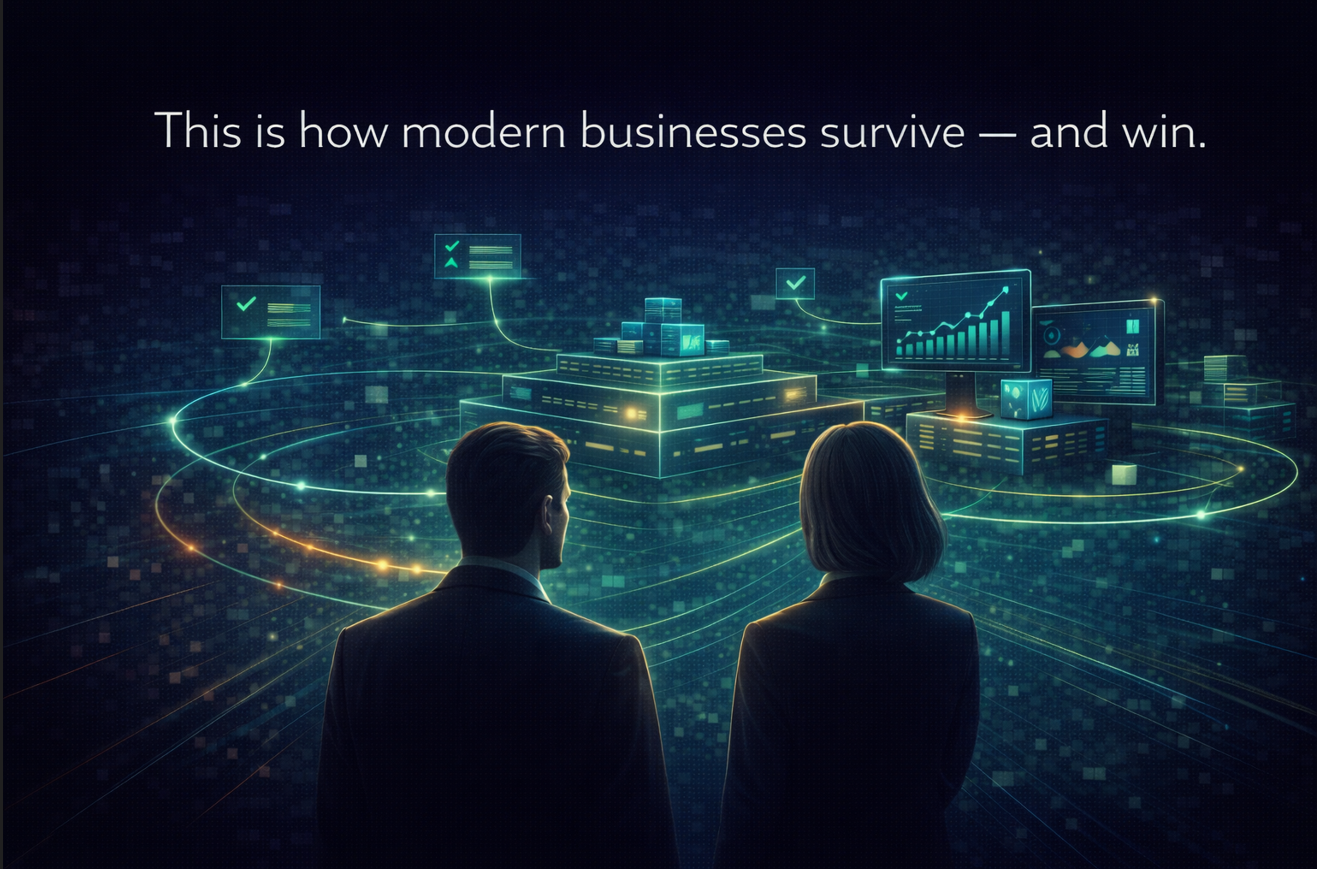
The shift is clear:
❌ Businesses that rely on outdated processes are becoming irrelevant.
✔ Businesses that operate in real time are dominating markets.
The winners of this decade will be companies that:
- automate early
- centralize data
- operate with clarity
- make decisions fast
- adapt instantly
- scale smoothly
Real-time is not just a technology advantage —
it is a survival strategy.
🚀 Averiq Solutions — Powering the Next Generation of Real-Time Enterprises
Averiq’s unified SaaS platform delivers:
- Real-time dashboards
- Automated workflows
- Unified ERP + CRM
- Inventory & payroll automation
- School management
- AI-ready systems
- Multi-branch visibility
👉 Book a Real-Time Enterprise Consultation — build the future of your business today.